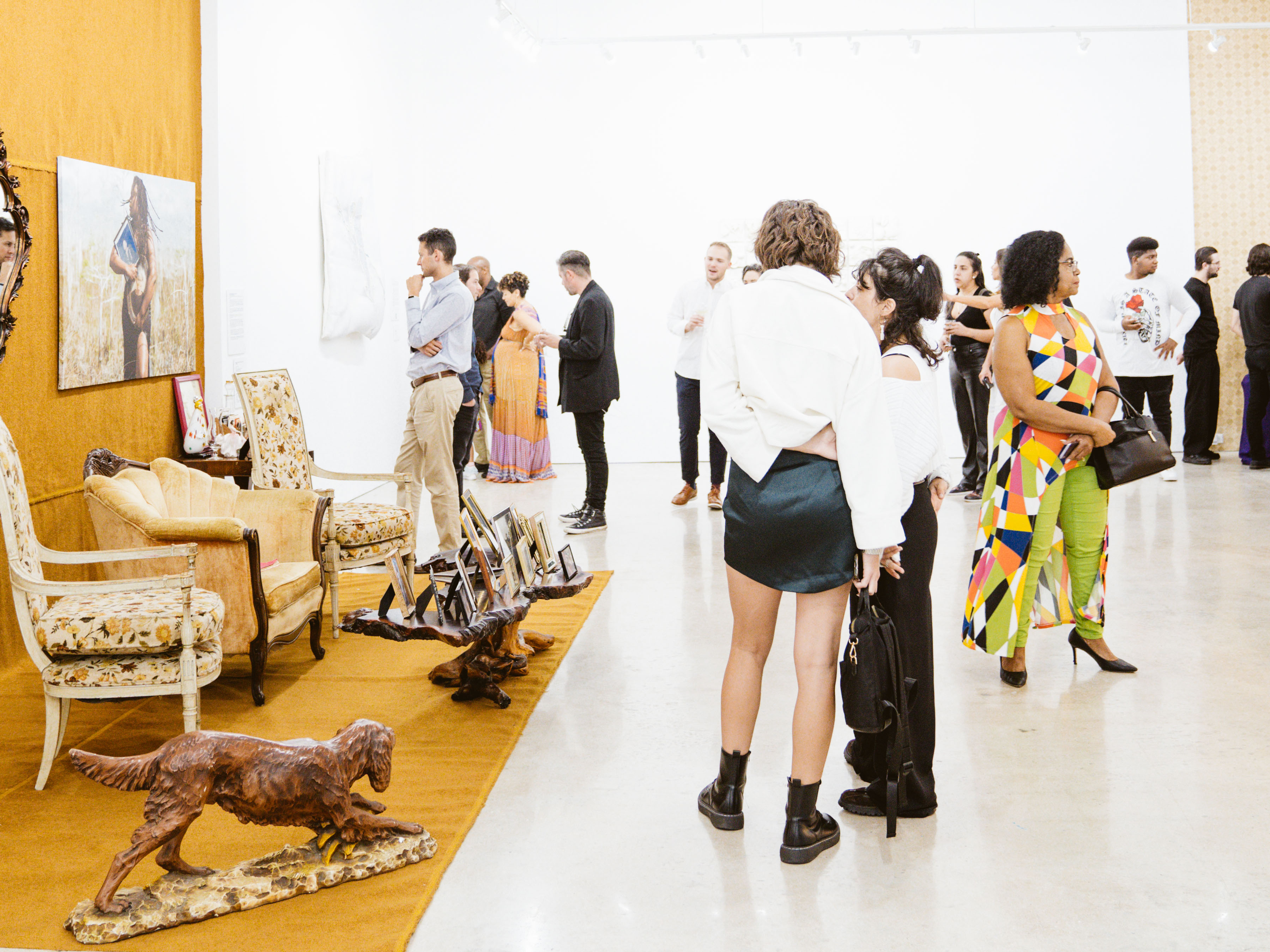

Diana Eusebio is a Peruvian-Dominican multidisciplinary artist based in Miami. Her artistic practice is centered on color and its cultural significance. She researches natural dyed textiles from Indigenous Latin American and Afro-Caribbean traditions, recognizing their connection to nature and their role as carriers of ancestral wisdom. Eusebio’s fusion of ancestral and modern techniques, including dyeing and photography, contributes to contemporary cultural preservation and celebrates the rich heritage and Pre-Columbian knowledge embedded within these communities. Her work is a powerful testament to the enduring cultural tapestry of these regions.
Eusebio holds a BFA in Fiber from the Maryland Institute College of Art. She has presented her work at the MoMa, Hall of Nations, Gregg Museum of Art and Design, and Rubell Museum. Studio residencies include Textile Art Center, NY, NY; Anderson Ranch Arts Center, Aspen, CO; Oolite Arts, Miami; AIRIE Fellowship, Everglades National Park; INDEX MECA Art Fair, Dominican Republic; Deering Estate Studio Residency, Miami. Notable awards include the Obama administration’s U.S. Presidential Scholar in the Arts–the highest national honor for a young artist-and the National YoungArts Jorge M. Perez Award for $25,000.
Ceiba
Photograph digitally printed on cotton fabric, quilted by hand, yellow dye extracted from marigold petals, indigo dye extracted from indigo leaves, live Spanish moss and branches harvested in Miami. 103 x 150 inches or 8.5 x 12.5 feet.
Ceiba invites viewers to pause beneath one of Miami’s eldest trees, to feel the sunlight shining between its thorny branches and breathe. Planted in 1915, this Ceiba pentandra, known as the Kapok tree, still lives in the Key Biscayne Village Green. Native to the Caribbean, Central and South America, and Africa, it was carried here across oceans, much like the people who would later make Miami their home.
The Ceiba stands as both immigrant and witness. When Eusebio visited and photographed the tree, she was struck by its immense stature. Kapoks can reach up to 230 feet tall. Its towering presence recalls the journeys of those who arrived seeking roots in new soil. It has endured, absorbed, and grown alongside the city’s shifting tides of migration, a silent archive of lives interwoven.
In Indigenous Caribbean and Latin American cosmologies, the Ceiba is the Tree of Life, the axis connecting underworld, earth, and sky. For the Maya and Taíno, it opened pathways to ancestors, holding memory in its trunk and branches. This mythology deepens the tree’s resonance in Miami, where lineages converge and histories overlap.
Today, in a climate of fear and propaganda against immigrants, this Ceiba tells another story: one of belonging through movement, of landscapes enriched by what has crossed borders. It reminds us that Miami’s culture and environment are not native – born, but grafted, exchanged, and shared. To stand beneath the Ceiba is to glimpse the history that binds us to land, to one another, and to resilience itself.